
When landlines were airborne
Hands up who used to have an Ericsson brick? I remember having a trusty Ericsson mobile phone back in the late 1990s (before switching to a Nokia in the early 2000s). But would you believe me if I told you that Ericsson was founded in 1876 (the year Bell patented his telephone) and that it started making telephones only two years later, as Bell did not hold the patent for Sweden?
Only a decade later, in 1886, Stockholm was the city with the highest number of telephones in the world and the greatest telephone density – more than London, Paris, and Berlin.
The only way to handle all this telephone traffic was to build a telecom tower. The 45-metre-tall tower was built in 1887 in the centre of Stockholm and at its peak had around 9,000 telephone wires attached to it (one per telephone).
Amazingly, this photograph shows the tower in 1890 when it had “only” about 5,000 cables attached.
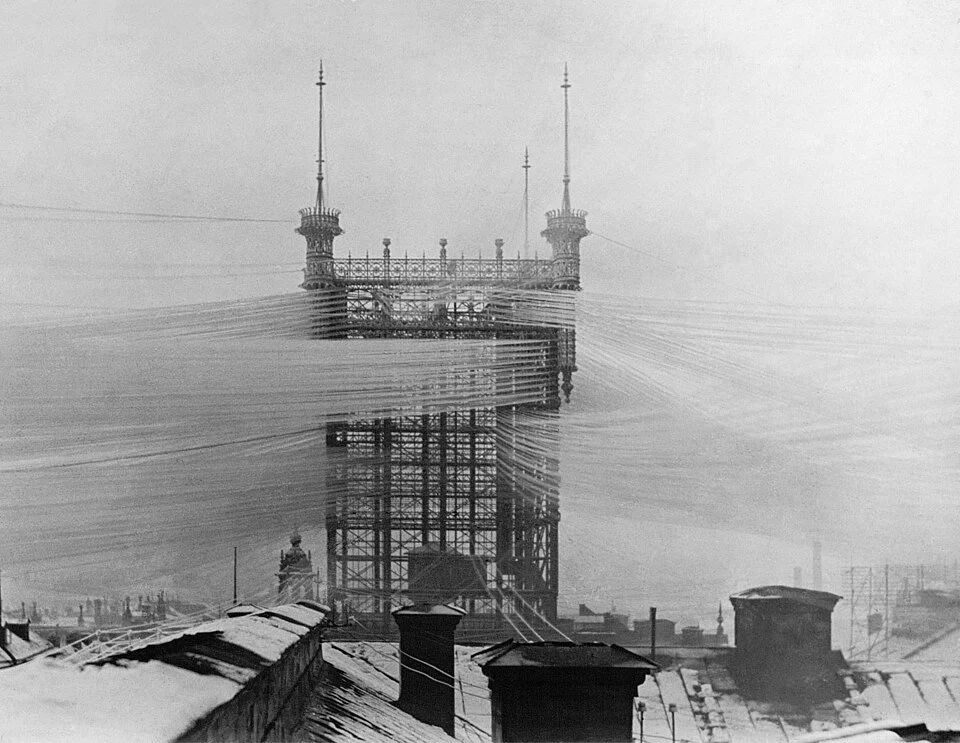
Unknown photographer, original from the National Museum of Science and Technology (Sweden)
The telephone tower was only used from 1887 for about twenty years, and by 1913, all telephone cables in Stockholm were subterranean.
In 1939, a revolving clock advertising the NK department store was mounted on the tower. The same clock now sits on the roof of NK.
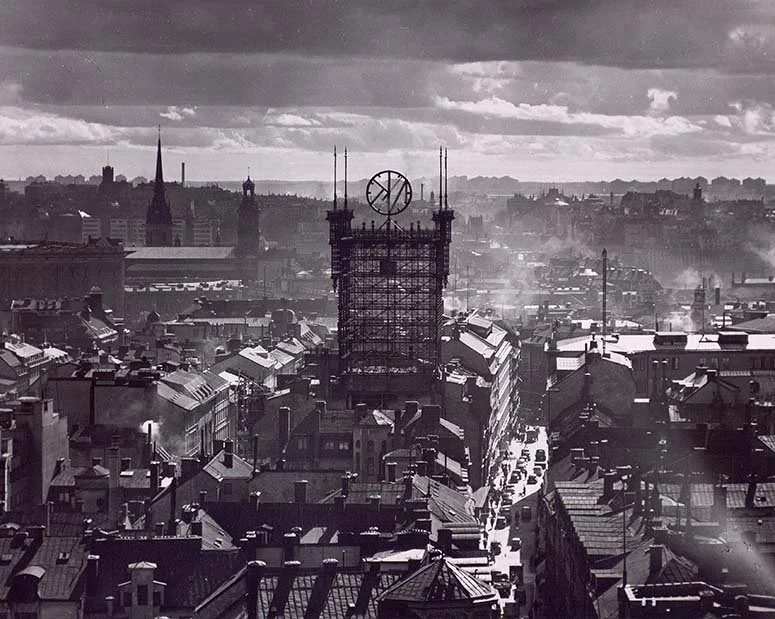
Photo: Hans Nyrén
The tower remained a focal point for the city, though, until it was demolished in 1953 following a fire.
Meanwhile, Sweden’s first telephone box was set up in 1901 in the central location of Kungsträdgården.
Telephone usage spread across the country, and by 1914, there were 42 telephones per 1,000 inhabitants in Sweden, compared with 17 telephones per 1,000 inhabitants in the UK and eight per 1,000 inhabitants in France.
In The Third Letter, I have a scene set in 1947 in which Clara receives a fateful telephone call on their newly installed home phone, but now I am wondering if I need Ester in Codename Charlotta already to have a telephone in her Stockholm flat in 1943 – and how this could affect the story…